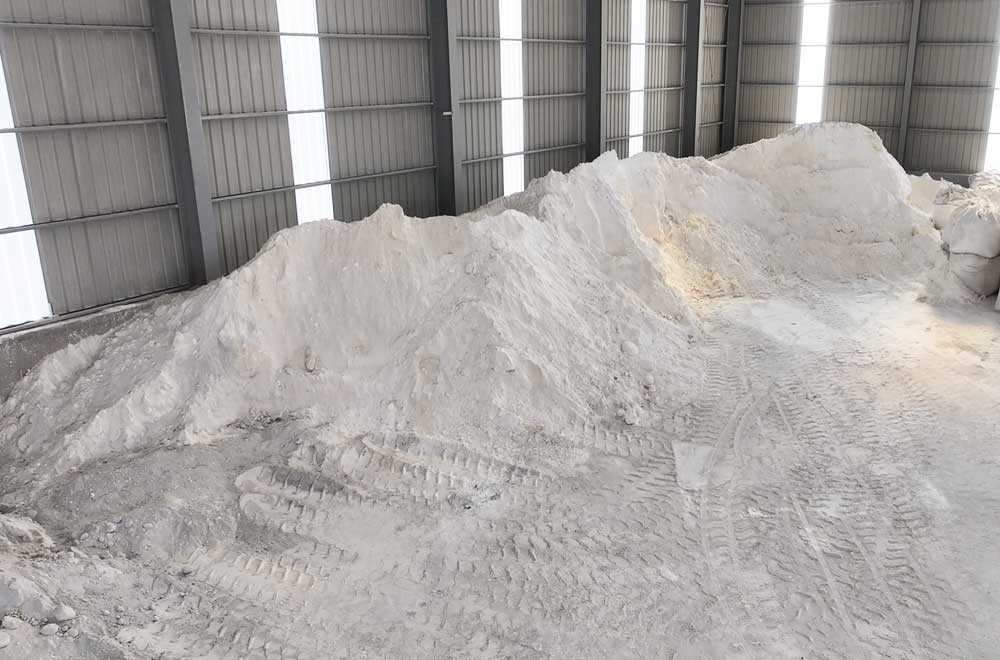
This process involves the full utilization of the residue discharged during the production of hydrofluoric acid. When hydrofluoric acid is produced by the reaction of fluorite and sulfuric acid, a residue containing 12% to 14% sulfuric acid is generated. This residue is neutralized with lime milk or clay slurry, filtered, and dried to become fluorogypsum. The amount of residue produced is related to the hydrofluoric acid production technology; 4 to 4.5 tons of fluorogypsum are discharged for every ton of hydrofluoric acid produced.
The chemical composition of fluorogypsum is (%): CaO 32–38, SO3 39–50, SiO2 0.4–0.6, Al2O3 0.01–2.00, Fe2O3 0.05–0.25, MgO 0.1–0.8, CaF2 2.5–6.5; ignition loss (400℃) 3.0–19. Fluorogypsum is an important industrial and building material. It can replace natural gypsum as a retarder in various silicate cements, and can be used as a sulfate slag cement and mineralizer, building blocks, flooring and building plastering materials, slag brick additive, reinforcing gypsum fiber decorative panels and building paper-faced gypsum boards, ceramic gypsum molds, etc. Fluorogypsum has the characteristics of fine particles, no need for crushing, convenient use, and stable quality. Its application technology is mature and its scope of application is quite wide. Cement plants such as Dongjiang Cement Plant in Hunan, China, use fluorogypsum from Xiangxiang Aluminum Plant to replace natural gypsum as a cement retarder without adversely affecting cement quality, ensuring that nearly 100,000 tons of fluorogypsum from Xiangxiang Aluminum Plant are effectively utilized annually. During storage and transportation, fluorogypsum is prone to caking and hardening into large lumps when exposed to water or rain. Therefore, rain protection is necessary during transportation, and it should be stored indoors after arriving at the factory.